20 Species, 80 Trees, One Forest, and a Year That Changed My Perspective
Some experiences don’t just add a line to your résumé – they change the way you see the world. For me, that experience was the Lancaster Watershed Leadership Academy.
I joined the program in December 2024 as part of a cohort of emerging leaders brought together by Lancaster Clean Water Partners. Over the course of a year, we explored watershed science, community organizing, and field investigations across the county.
I came in curious and green. I left with a deeper understanding of what sustainability means across rural and urban landscapes, a network of people I genuinely admire, and a confidence in my own voice that I hadn’t expected to find.
In addition to my studies at Temple University, I credit this experience for giving me the base to take on my current position at the Fairmount Water Works. My final year of college has been a blur, but I have grown more this year than in my previous three. It didn’t just teach me about water, but about the different ways our lives are connected through our environment and what that means for the future.
A different kind of planting
Every program at Lancaster Watershed Leadership Academy culminates in a community-driven watershed project. When it came time to plan ours, I thought about my background as an urban forestry intern. Specifically, about how much conventional tree planting leaves potential on the table.
Typical landscaping spaces out individual trees across maintained turf, 1-2 meters apart. It looks manicured, but it doesn’t create habitat. It doesn’t cool the air the way a dense canopy does. It doesn’t foster the understory complexity that makes a forest a living ecosystem.
So, working with a fellow program scholar, I proposed something different: a Miyawaki Method micro-forest.
The Miyawaki Method, first developed by Japanese botanist Akira Miyawaki, involves planting native, multi-species vegetation at extremely high density, roughly three plants per square meter. The result is a forest that establishes 10 times faster than conventional planting, grows denser, sequesters more carbon, and creates far richer wildlife habitat in a fraction of the space. Instead of landscaping, it’s an ecological restoration in miniature.
The numbers behind the forest
- 80 native plants across 22 species
- ~25 sq meters
- $1,000 total budget
Plants were sourced from Octoraro Nursery, the Alliance for the Chesapeake Bay, and the Lancaster County Conservation District; a supply chain that kept dollars local and species native.
The community that made it real
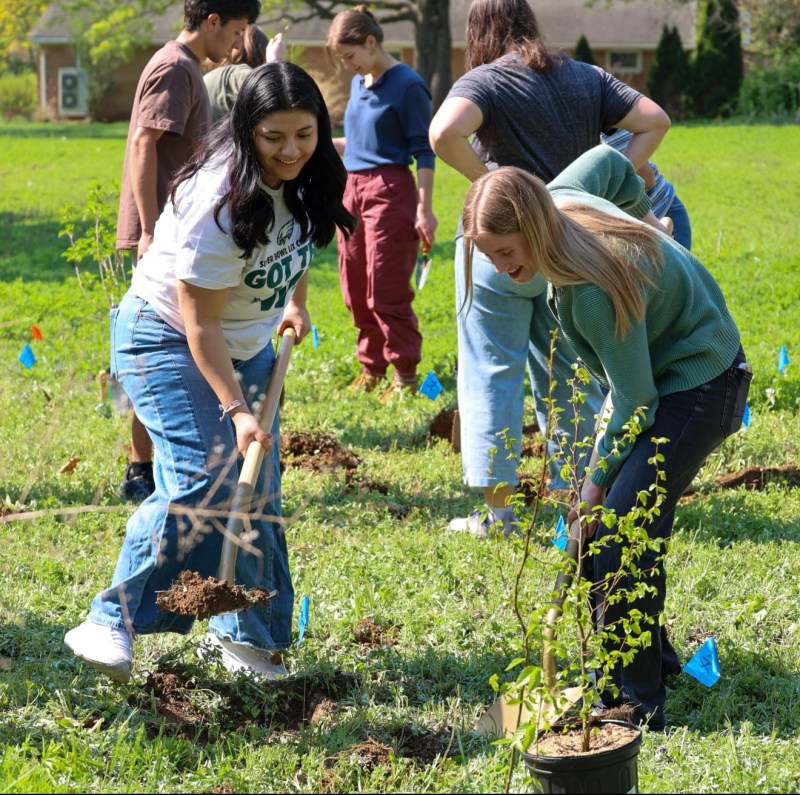
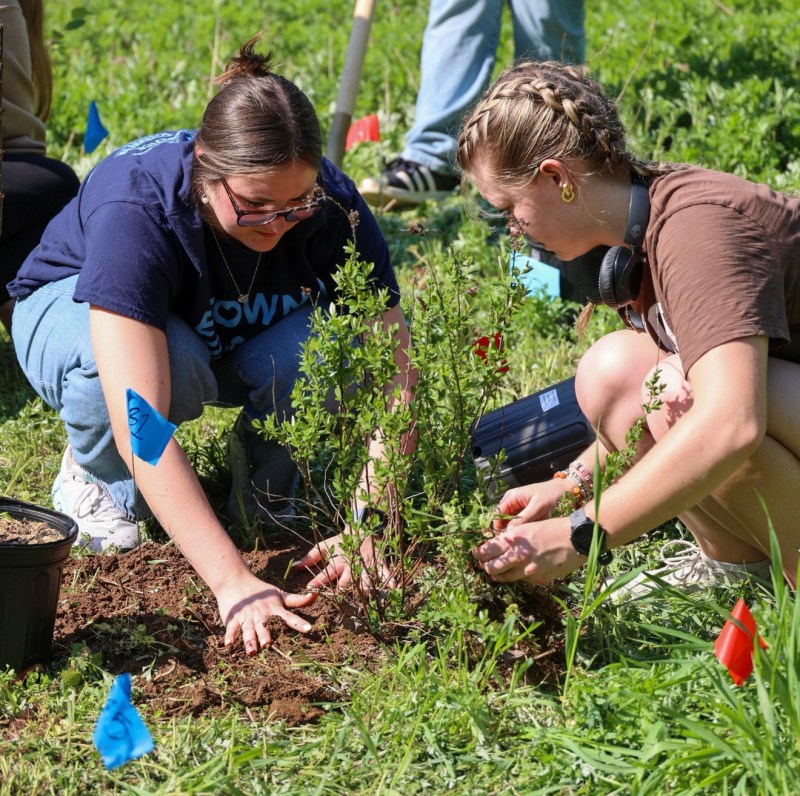
None of this happens without people. We’ve been lucky to work closely with Elizabethtown College, their professors in ecology and biology, and a student community that showed up with both hands and genuine enthusiasm. Volunteers from the Conoy Creek Watershed Association rounded out a planting crew of 20 to 30 people on the day.
On April 22nd, Earth Day, at 3:45pm, that crew gathered on the E-Town campus and planted 81 trees together.
Maintenance will continue for two to three years, sustained largely by the E-Town community. This project is more than just stewardship, it’s ownership. The forest will grow because people chose to invest in it. This isn’t just about trees, it’s about the people. Local residents and volunteers of all ages plant, care for, and learn from a forest together.
My favorite moments were when two ladies walking through the neighborhood stopped to talk with me about how much they had been wanting someone to plant trees here. They were so enthusiastic about our project, and this is the kind of excitement I was hoping for!
What I hope this models
It’s been roughly eight months from the first sketch to the first tree in the ground. I won’t pretend there were no bumps in the road. However, I think that’s part of what makes this project meaningful. It required patience, collaboration, and belief that something unconventional was worth doing.
This forest will serve as a living classroom, a green space for healing and rest, and a proof of concept. What if more of our urban landscaping looked like this? What if every campus, every schoolyard, every vacant lot had a micro-forest instead of a row of isolated trees?
I’m grateful to Lancaster Clean Water Partners for trusting a curious business management major with a real budget and a real problem. I’m grateful to Elizabethtown College and the Conoy Creek Watershed Association for saying yes. And I’m grateful to every person who picked up a plant and put it in the ground.
The forest is planted and now we watch it grow.